
Delete These 13 Clunky Phrases From Your Resume If You Actually Want To Get Hired
 Lais Schulz | Canva
To a writer, a high word count means you sat your butt down and wrote. (Congrats! Especially now that TikTok exists, that’s not easy.) But to an agent or an editor, a high word count is a giant red flag. It means you have no idea how to self-edit your work.
I’m both a professional writer and editor. I get paid good money to use my English degree, I bagged a literary agent for my memoir, and I’ve had a growing list of clients since 2016. Ultimately, I’m not successful because I can string fancy sentences together; I’m successful because I know what to cut for clarity.
By the time my agent or editor gets my work, it’s alreadypunchy and polished. My job is to make their job as easy as possible — and that’s why I still have a job in a notoriously difficult industry.
Delete these 13 words from your resume (and your own writing) if you actually want to get hired:
1. 'It’s important to note that'
This phrase has always been one of my pet peeves. (If it’s not important to note, why are you noting it in the first place?) These days, it also makes me think you used ChatGPT, since the AI bot includes this phrase in almost every response.
Delete it, and your note ironically seems way more important.
- Before: “It’s important to note that most readers skim.”
- After: “Most readers skim.”
2. 'From ____ to ____'
Some writers use this set-up to encompass a broad range of ideas, but it reads as a vague, cliché copout. (It’s also another ChatGPT giveaway.) Instead, figure out exactly what you want to portray and list specifics.
- Before: “From anxiety to excitement, most people feel a huge range of emotions before they go out on stage for a public speaking event.”
- After: “Before you go out on that stage, you’ll feel it all: anxiety, excitement, panic, possibility, and the urge to vomit.”
Novice writers believe that vagueness is relatable, but in actuality, it’s forgettable. Specificity builds credibility and connection with your reader.
3. 'In order'
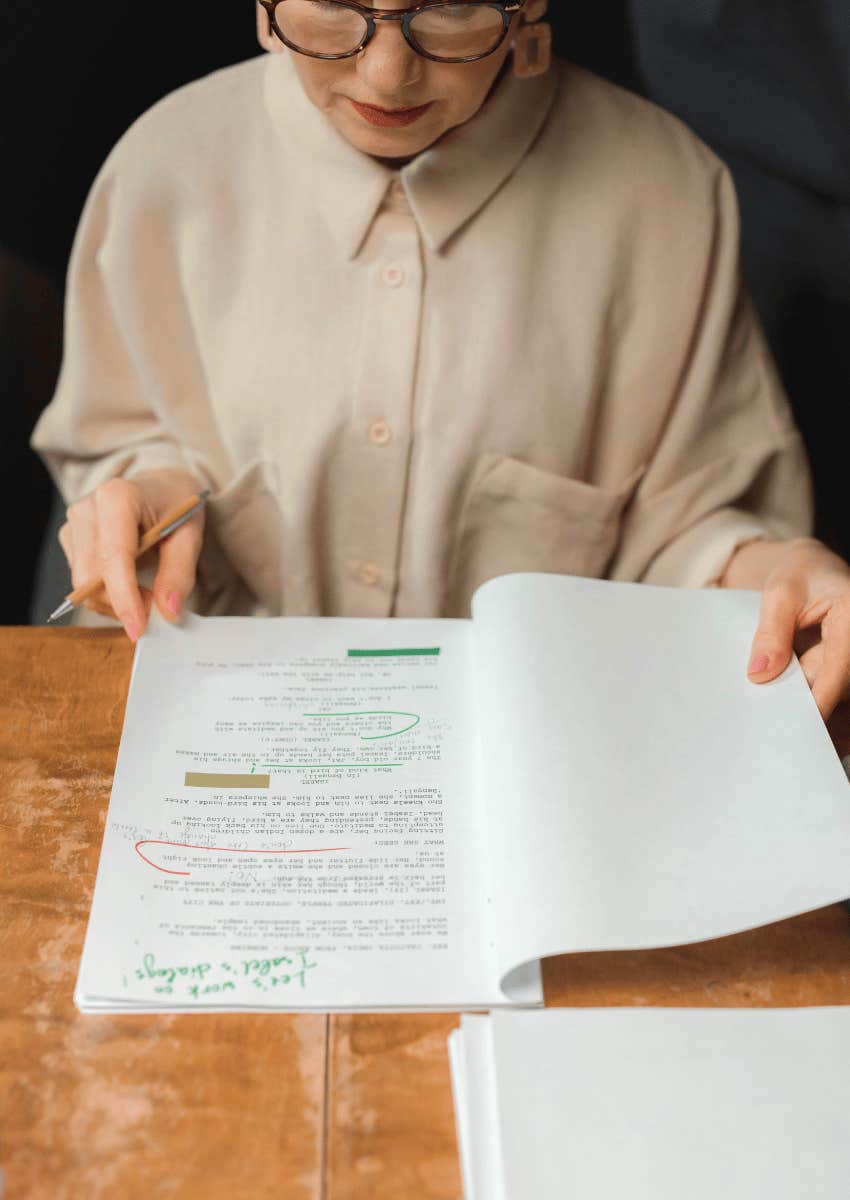 Ron Lach / Pexels
Delete these two unnecessary words, and the meaning won’t change — but it will minimize verbal clutter.
- Before: “Every day, the intern worked until 8 p.m. in order to impress his boss.”
- After: “Every day, the intern worked until 8 p.m. to impress his boss.”
4. 'In my opinion/I think'
Theoretically, if you’re the author, everything you say is your opinion, and opinions are dime a dozen. Instead, do some research and back up your opinions with facts.
- Before: “In my opinion, smartphones and social media are ruining people’s attention spans. Now, I don’t think anyone can focus for more than a few seconds at a time.”
- After: “According to a study from Microsoft, the average human attention span is now 8.25 seconds, and it’s because of social media.”
5. 'There is/there are/it is'
I see this constantly, even in traditionally published books, and it drives me up a wall.
When you start your sentence with “There was” or “It is,” what is the subject? As pro editor Don McNair explains in his book Editor-Proof Your Writing, these passive phrases are called expletive constructions, and they steal the focus and power from your writing:
“‘There’ and ‘It’ have no specific meanings on their own. When we get rid of expletive constructions, we put more action into the sentence, make its meaning clearer, and often eliminate words. […] When we say ‘It is storming,’ the ‘It is’ doesn’t refer to something specific.
Typically, we can make these sentences active by simply dropping the expletive construction, or by dropping the expletive construction and adding a verb.”
- Before: “There were cobwebs all over the wooden fireplace mantel.”
- After: “Cobwebs coated the wooden fireplace mantel.”
On a similar note, “There is research that shows…” zaps your claim of its credibility, granted it sounds like this vague research is floating around in the ether. Attribute it to a specific source, and it instantly sounds more trustworthy:
- Before: “There is a study that found…”
- After: “A 2024 study from the scientific journal Nature found…”
And last but not least, this annoying ChatGPT phrase: “It’s not about ____; it’s about ____.” Please, for the love of Merriam Webster, stop using this format. What does the above “it” refer to? If you don’t know, don’t say it.
6. '____ had ____ that'
 Andrea Piacquadio / Pexels
Another editing suggestion from McNair, this structure focuses on a physical attribute that someone has(often something that everyone has, like hair, eyes, or a face) rather than jumping straight into the description using possessive adjectives.
- Before: “She had blonde hair that grazed her lower back.”
- After: “Her blonde hair grazed her lower back.”
It can also apply to inanimate objects, and in most cases, you can find a way to delete “had” and “that.”
- Before: “The house had windows that overlooked the ocean.”
- After: “The house’s windows overlooked the ocean.”
7. 'Kind of/Sort of'
People use “kind of” and “sort of” to water down how they truly feel, usually in an attempt to soften their opinions or prevent themselves from sounding impolite. (Statistically, women use softening language way more than men, especially in the workplace.)
These phrases have no place in punchy writing. Say what you mean and mean what you say.
- Before: “I’m kind of tired of this.”
- After: “I’m tired of this.”
8. 'Just'
An editor from a Big Five publishing house taught me this invaluable tip: 99% of the time, “just” is a useless word. Unless you’re expressing how recently something happened (“I just got back from the store”), removing it won’t change the meaning of your sentence — yet people just throw it in anyway.
When I pressed ctrl + F and searched my first manuscript for “just,” I was stunned to find I’d used it over 300 times.
- Before: “I just wanted to say thank you.”
- After: “I wanted to say thank you.”
9. 'That'
 Anna Shvets / Pexels
The word “that” is often unnecessary, too — but not always.
In her book Woe Is I: The Grammarphobe’s Guide to Better English in Plain English, editor Patricia T. O’Conner suggests using “that” after thinking verbs, like “decide,” “know,” “realize,” and “believe.”
Otherwise, if the sentence makes sense without it, cut it.
- Before: “I heard that the company that Sarah works for announced that layoffs were coming.”
- After: “I heard Sarah’s company announced upcoming layoffs.”
10. 'Really/very/so'
Every time you catch yourself using “really,” “very,” or “so,” see it as an opportunity to choose a stronger verb, adjective, or noun.
So tired = exhausted. Really yellow = marigold. Very beautiful = stunning. Ate really quickly = devoured. Walked very slowly = trudged.
- Before: “He ran very fast through the airport, really wanting to get home.”
- After: “He sprinted through the airport, desperate to get home.”
11. 'Totally/completely/definitely/literally'
Again, these words are filler, and removing them rarely changes the meaning of your sentence. Like “very” and “really,” they’re usually an indicator that you could’ve chosen a stronger word.
- Before: “The bag was totally filled with clothes.”
- After: “The bag was stuffed with clothes.”
The exception here is “literally,” which means that something actually or physically happened without exaggeration. Unfortunately, some people now use it as a stand-in for its opposite: figuratively. When you throw it in for emphasis, the mental image is often horrifying:
- Before: “He literally jumped out of his skin.”
- After: “He jumped out of his skin.”
12. 'The fact of the matter is'
I owed $80,000 in student loans for an English degree, and I still have no idea what this phrase means. Like “it’s important to note,” your attempt to add emphasis actually weakens your sentiment.
- Before: “The fact of the matter is, everyone thinks they’re a good listener until proven otherwise.”
- After: “Everyone thinks they’re a good listener until proven otherwise.”
13. 'It goes without saying/needless to say'
Full transparency: I’m guilty of this one. It’s my biggest writing tic, but I’m trying to purge it from my prose, because it doesn’t make sense: If it goes without saying, why the hell am I saying it?
- Before: “Needless to say, kindness matters.”
- After: “Kindness matters.”
A word on voice: Every time I write an article about cutting verbal clutter, someone inevitably comments: “But this is my voice. I write the way that I speak. Why are you trying to rid my incredible vocabulary of everything that makes it unique and relatable?”
Short answer: No one is holding you hostage and forcing you to self-edit. If you don’t want to, don’t.
Long answer: Has an acquiring editor asked to publish your diary? Unless you’re Anne Frank, odds are no one wants to read your unfiltered monologues. Self-editing makes your writing as clear and engaging as possible — and since editors and agents typically reject work within 10 seconds, every word matters.
I’m not trying to strip your writing of its personality. I’m trying to strip your writing of subconscious crutches that, to professionals, read like mistakes.
Once you learn these rules, you can decide when and how often to break them. Soften the language of your protagonist, on purpose, for characterization. Throw a “just” into dialogue for realism. Use “literally” correctly to emphasize, “Yep, that actually happened.”
But if cutting out verbal clutter eradicates your “voice” altogether, you’re probably confusing wordiness with substance.
Maria Cassano is a writer, editor, and journalist whose work has appeared on NBC, Bustle, CNN, The Daily Beast, Food & Wine, and Allure, among others. She's in the process of publishing her memoir.

