
People Raised By Overbearing Moms Often Develop 5 Lasting Traits As Adults, Says Therapist
 Brocreative | Shutterstock
Jim Brillon is a licensed therapist based out of California, yet he uses the reach of his TikTok following to offer educational posts surrounding mental health and its relational effects. In one his videos, Brillon broke down one archetype of motherhood called the "devouring mom," which he defined as the “shadow side of the mother archetype.”
What is a devouring mom? A devouring mom or an emotionally overbearing mom is an analytical term for someone who employs a parenting style that “consumes their children psychologically and emotionally, instilling guilt in them for leaving or for becoming an autonomous, independent human.” There are endless permutations of parenting styles that moms can choose from to raise their children. On one end of the spectrum are silky moms, who rely on whatever product or technique lets their lives run smoothly.
Crunchy moms land on the opposite side of that spectrum, as they tend to have a singular focus on attachment parenting. Of course, some moms land in the middle of any given style, for whom flexibility is key.
A devouring mom type is similar in some ways to an eggshell mom, whose unstable moods have her kids walking on eggshells, tailoring their behavior to her needs. Children of both eggshell moms and devouring moms learn that their moms' emotional landscapes take precedence over their own needs. Yet there are ways to heal from having a devouring mom, starting with recognizing the archetypal pattern.
People raised by emotionally overbearing moms often develop these lasting traits as adults:
1. They often struggle to separate from others after growing up with blurred boundaries
The core of the emotionally overbearing mother type is rooted in a deep fear of being alone. That might manifest as a parent who maintains any developmentally appropriate move towards autonomy is a form of abandonment, as opposed to a natural part of the growing-up process.
Someone who infantilizes their kids doesn’t shift their parenting style as the child develops and grows more mature. There isn’t one definitive type of infantilization, yet there are various common forms of the behavior, including expressing extreme disapproval or negative judgments about their kid’s actions. A mom who infantilizes her children is often scared of not feeling needed.
Often, infantilization occurs because a parent doesn’t want their child to grow up and grow into a separate person from them, which can not only be damaging to a kid’s self-esteem and sense of self-worth, but it can also stunt a child’s emotional development, even leading to depression or anxiety.
One way to counteract infantilization is to set firm boundaries that you explain in clear, direct language. Sharing the reasoning behind your decision can help contextualize your choice. If your parent is resistant to the boundaries you’re setting, it’s okay to take space and walk away from the situation.
2. People raised by overbearing moms become people pleasers
 Getty Images / Unsplash+
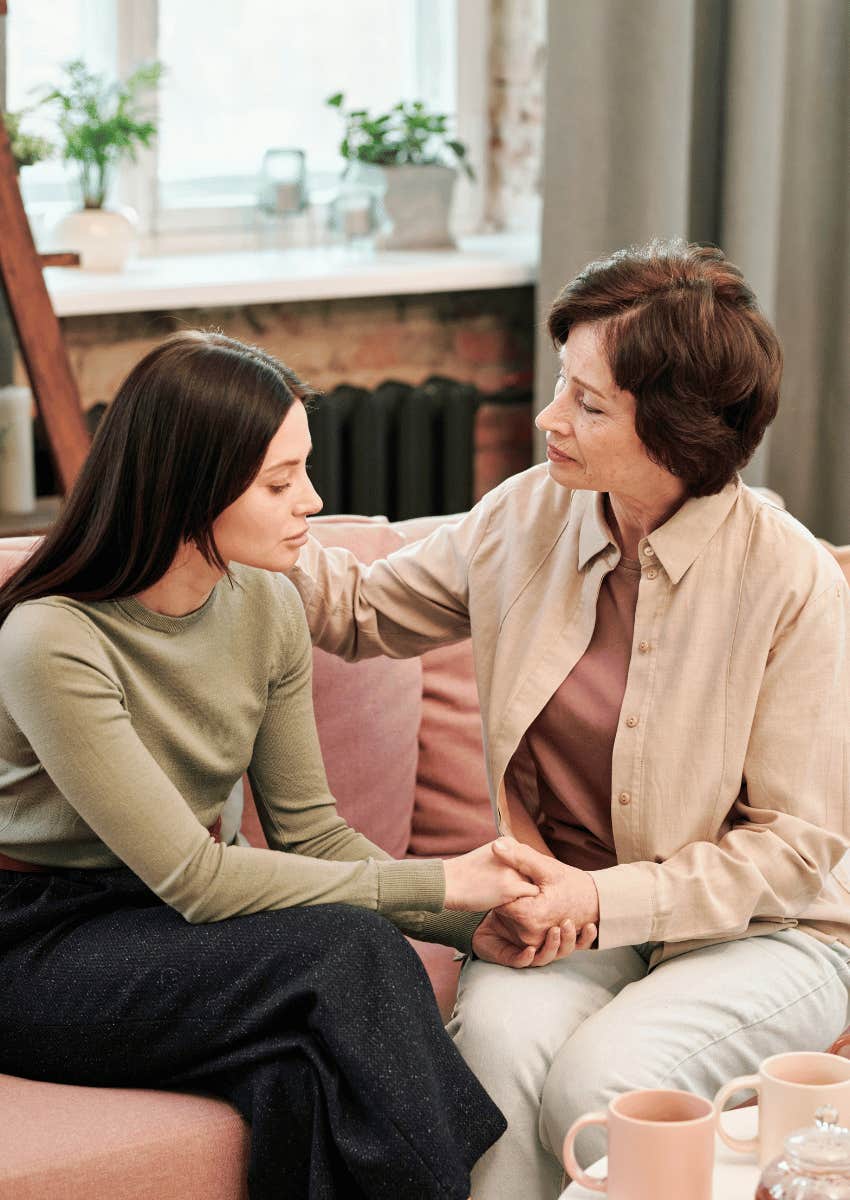
An emotionally overbearing mom can often wield her authority as the parental figure in a way to ensure her own needs are prioritized over the needs of her kids. While there’s no singular prescriptive pattern of behavior for a devouring mom type, that mom’s controlling personality could extend to how she thinks and talks about herself, and how she acts toward her kids, other family members, and friends.
Brillon offered the example that a devouring mom might not let her kids choose or even have their own friends, whether they’re in their younger years or as teenagers. This operates as a way to isolate kids and make them dependent on their parents for emotional support and companionship.
For kids who were raised with an excessively controlling parent, working to set boundaries, making your own decisions about your life, and maintaining the understanding that you are your own person can all function as a form of healing.
Couples counselor Dr. Rhoberta Shaler explained that a controlling mother teaches her children early on that their worth comes from making her look good and doing what she wants, quietly turning them into people-pleasers who spend years putting everyone else's needs before their own. As an adult, that pattern shows up in your relationships, your career, and even in how you talk to yourself.
3. They feel responsible for other people's needs
Guilt is a deeply complex emotion, one that experts are continuously researching and recontextualizing to better understand how it functions.
Research from Psychology Today notes that a mom who utilizes guilt trips might do so in order to get her kids to fulfill her needs before their own. Guilt can function as a way to get what you want. Yet using guilt often pushes people away, or makes them feel bitter and resentful.
One way to react to an emotionally overbearing mom who’s always guilt-tripping you is to aim for compassion while setting firm boundaries. You can acknowledge what your mom wants you to do without actually doing it, even if that hurts her feelings.
Keep your own needs in mind and set boundaries as you see fit. Remember that setting boundaries doesn’t make you a bad person; it just means you’re prioritizing what you need to feel stable and healthy.
4. People raised by overbearing moms often struggle with independence
 Gabriel Ponton / Unsplash+
There exists an innate expression of protectiveness in any mother. It’s how parents ensure that their kids survive and thrive.
Yet being overprotective goes beyond the range of what’s considered appropriate for a child’s age. It ties into infantilizing and controlling behavior, which, at their root, occur because an overbearing mom is scared to be left alone.
When a child grows up without enough space to develop their own sense of self, psychologist Dr. Jonice Webb explained that "these messages take root early and well" and prevent kids from making the right choices and valuing themselves as adults. Learning to be independent as an adult is a lot harder when you were never given the chance to practice that skill as a kid.
5. They often feel responsible for other people's emotions
Enmeshment can also be known by another phrase, an unhealthy dynamic that can occur when parents rely on their children for emotional support, instead of being pillars of emotional support for their children.
Clinical psychologist Dr. Samantha Rodman Whiten noted that there are various ways to subvert a parent who assumes the role of the victim, a tactic that might be used by a devouring mom.
Whiten explained that having a network of people outside of your biological family can serve as a way to “reality check” yourself, which can be especially helpful if the boundaries you set are being crossed. She noted that if your parental relationship isn’t giving you the kind of support you need, you’re allowed to choose who you want to be close to, and who you want to support and be supported by.
She continued, “While you will always be linked to your family of origin, you can think outside the box and have deeper relationships with chosen friends, or extended family members.”
People who have grown up with this type of emotionally overbearing mom, or someone who is a devouring mom type herself, can seek professional support in the form of counseling or therapy. Recognizing the devouring behavior and acknowledging its effects is the first step to navigating healthier, more emotionally stable relationships.
Alexandra Blogier is a writer on YourTango's news and entertainment team. She covers celebrity gossip, pop culture analysis, and all things to do with the entertainment industry.

