
Couples Who Run Into This Issue In Their First Year Of Marriage Face A 67% Higher Divorce Risk, Experts Say
 PintoArt | Shutterstock
Full transparency: I haven’t always been the best person. At the height of my dissociative disorder, I was cold, detached, and dismissive. I was also way too dependent on male validation.
But one thing I never did? Ditch my friends every time I get into a relationship.
Experts say couples who run into this issue in their first year of marriage face a 67% higher divorce risk
 Joel Muniz / Unsplash
I’ve known my oldest friend for 33 years (I’m 34; we met as literal toddlers), and we still talk on the phone weekly. I also go out to dinner with my elementary-school besties, see my high-school bandmates for the holidays, and have a group of five girlfriends who regularly plan craft nights and lake days.
I’ve always set aside time to see my friends alone, whether I was dating someone or not. It’s a non-negotiable for me. Fortunately, research shows that people who maintain lifelong friendships are better adjusted, experience less hostility and anxiety, and feel more satisfied with their lives.
Unfortunately, as a woman, these lifelong friendships also increase my risk of divorce.
A woman’s social circle could destroy her marriage
In 2017, the Journal of Social and Personal Relationships published a study about how couples’ friends impact divorce. Researchers followed 355 newlywed couples over 16 years.
During the first year of marriage, researchers asked both the husbands and wives questions like: “About how many good friends could you call on for advice or help if you ever needed it?” and “Does your wife/husband have friends that you would rather she/he not spend time with?”
Among white couples, when the husband approved of his wife’s friends, the marriage survival rate was approximately 70% after 16 years. But when the husband disapproved of his wife’s friends, that number dropped to 50%.
In other words, if a man didn’t like his wife’s friends from the get-go, the couple was 67% more likely to get divorced later on.
And if a husband felt that his wife’s friends actively “interfered” with their marriage, the likelihood of divorce nearly doubled. This factor affected a marriage more than income, education, or children.
But the most interesting part: When the wife didn’t like the husband’s friends, it had no significant impact on the divorce rate.
The same study also showed that “couples in which the wife reported more shared family support were more likely to divorce,” too.
So what gives? Why does a woman’s social circle act as a potential wrecking ball for a relationship, while a man’s social circle barely moves the needle?
It’s probably not because a woman's friends are "bad influences"
According to a recent survey of 2,000 women, 83% said their ideal girls’ night involved unstructured conversation in a quiet environment. (The majority of straight married women don’t maintain close friendships with people of the opposite gender.)
Meanwhile, men are twice as likely to binge drink, gamble, and use drugs, 143% more likely to drive while intoxicated, 26% more likely to hang out with women who are not their wives, 54% more likely to cheat on their spouse, and 390% more likely to attend adult clubs.
If anything, the husband’s friends are probably worse influences, but women largely don’t let it ruin their marriages. So why are men so threatened by their wives’ friends? In my opinion, it all boils down to codependency, insecurity, and isolation.
First of all, men statistically have far fewer friendships than women. Only 27% of men report having a handful of close friends, and most of them wouldn’t open up to a buddy if they were struggling. Roughly 15% of young men have no close friends at all.
As a result, most men solely depend on their partners for socialization, support, and emotional regulation. When wives invest time and effort into relationships outside of their marriages (as they often do), husbands may feel neglected, overlooked, and somewhat jealous. Second, women’s support systems usually demand accountability.
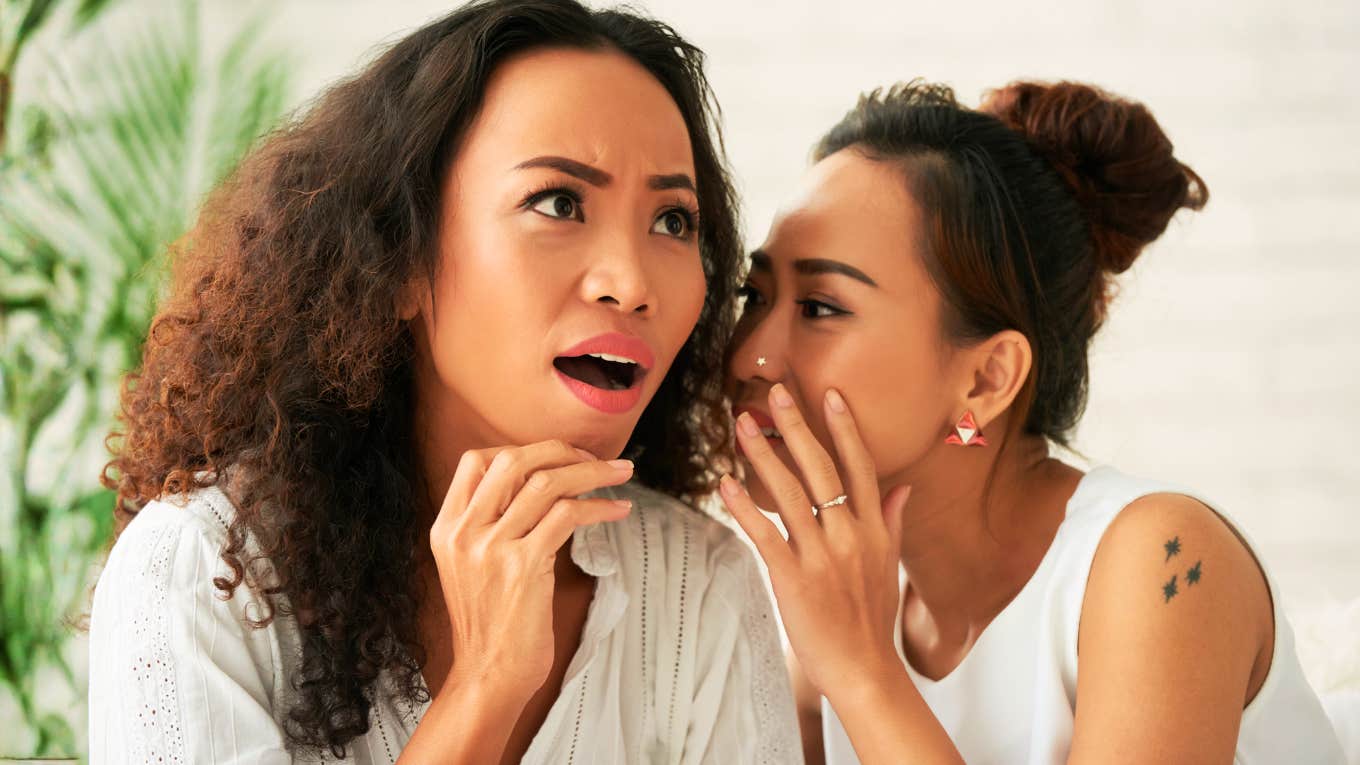
Women actually talk to their friends about their relationships
 Marea Wellness / Unsplash
Our culture loves to paint women as “gossips,” but gossip has plenty of benefits. This vulnerable, honest communication is how we keep ourselves grounded. Bonded. Empowered. Safe. Alive. The word “gossip” originates from the Old English word “godsibb,” which meant “close friends” and “companions in childbirth.”
Throughout history, women’s whisper networks served as survival strategies. Over birthing beds and laundry lines, we shared wisdom, wellness, and most importantly, warnings. Those habits die hard — because they still serve us.
“Women are much more likely to discuss marital problems with their friends,” said Stephanie Roth Goldberg, a social worker and clinical therapist. “This leads to getting opinions on their relationship,” and sometimes, those opinions are not good.
If a man is insecure, his wife’s transparency with her friends might bother him. If a man is downright abusive, it’s the kiss of death, and he knows it — so he tries to isolate her.
Over 20% of women experience intimate partner violence, and isolation is often the first indicator of emotional and physical abuse. Toxic partners gain control by separating you from your support system, so you can’t depend on anyone else for perspective, advice, or belonging.
Guess what? Abusers “never liked your friends,” and they always “think you should stop hanging out with them.” Women’s friends are witnesses, and if someone’s going to get away with a crime, all the witnesses have gotta go.
Once you’re alone, the abuse gets worse and worse. If I had to bet, most of those marriages ended because the wife’s so-called “problematic” friends told her, “This isn’t okay, and you need to get out.”
My soon-to-be husband likes my friends
But even if he didn’t, he’d need to respect my friendships. As I said, it’s a non-negotiable. No one person can be your everything. No matter how incredible your partner is, they cannot single-handedly check all your boxes or meet all your needs. That’s where platonic love comes in.
My female friendships are like therapy to me: I show up as the most raw, authentic version of myself, and they accept me exactly as I am. We unwind, we laugh, we vent, we celebrate, we mourn, we nurture each other, and yes, sometimes, we talk trash.
When you’re with the right person, your friendships do not weaken your relationship; they strengthen it. When you’re with the wrong person, genuine friends will let you know over a bottle of wine and some girl talk.
The solution is not for women to have weaker social circles. The solution is for men to stop being the types of people women need to warn each other about.
Maria Cassano is a writer, editor, and journalist whose work has appeared on NBC, Bustle, CNN, The Daily Beast, Food & Wine, and Allure, among others. She's in the process of publishing her memoir.

