
I’m 45 And The Hardest Part Of Parenting Teens Isn’t What Anyone Prepared Me For
 www.kaboompics.com | Pexels
I expected the raging hormone cocktail. I didn’t expect it quite so soon, but the mood swings and eye rolls and furrowed brows didn’t come as a huge surprise.
I’d always known I’d be in for it. My daughter has always liked to do things her way on her schedule, and she has long thought that the boundaries her hapless mother tried to impose on her were cute.
When she was four, I found her at the dining room table, looking thoroughly engrossed in page 128 of a recently and desperately purchased book called Setting Limits With Your Strong-Willed Child. Apparently, she was tired of my lame limit-setting attempts and was going to take matters into her own hands.
The book, by the way, was not at all helpful. If my child did not willingly go to her room for timeouts, it instructed me to pick her up and deposit her there myself. But by the time she was four, I was no longer physically capable of picking up my daughter against her will. She was tall, dense, and muscular, and could flail her way out of most any situation.
I haven’t tried to pick my daughter up in years. At age 14, she’s taller than I am and would most definitely beat me in arm wrestling. She still finds my boundary-setting capabilities laughable, though every boundary I now try to set is no longer cute; it’s SO UNFAIR, OMG ARE YOU JOKING RIGHT NOW?
I'm 45, and the hardest part of parenting teens isn't what anyone prepared me for
As a group, adolescents are not known for their kindness and tact, particularly where their parents are involved. And, for whatever reason, particularly when that parent is the mother.
Dealing with the sighs, jabs, and negativity has been harder on me than I’d like to admit. I made a pact with myself that I’d let this stuff roll off my back because engaging with it only magnifies its impact, and am I really going to let my feelings get hurt by indulging in some silly argument with a 14-year-old?
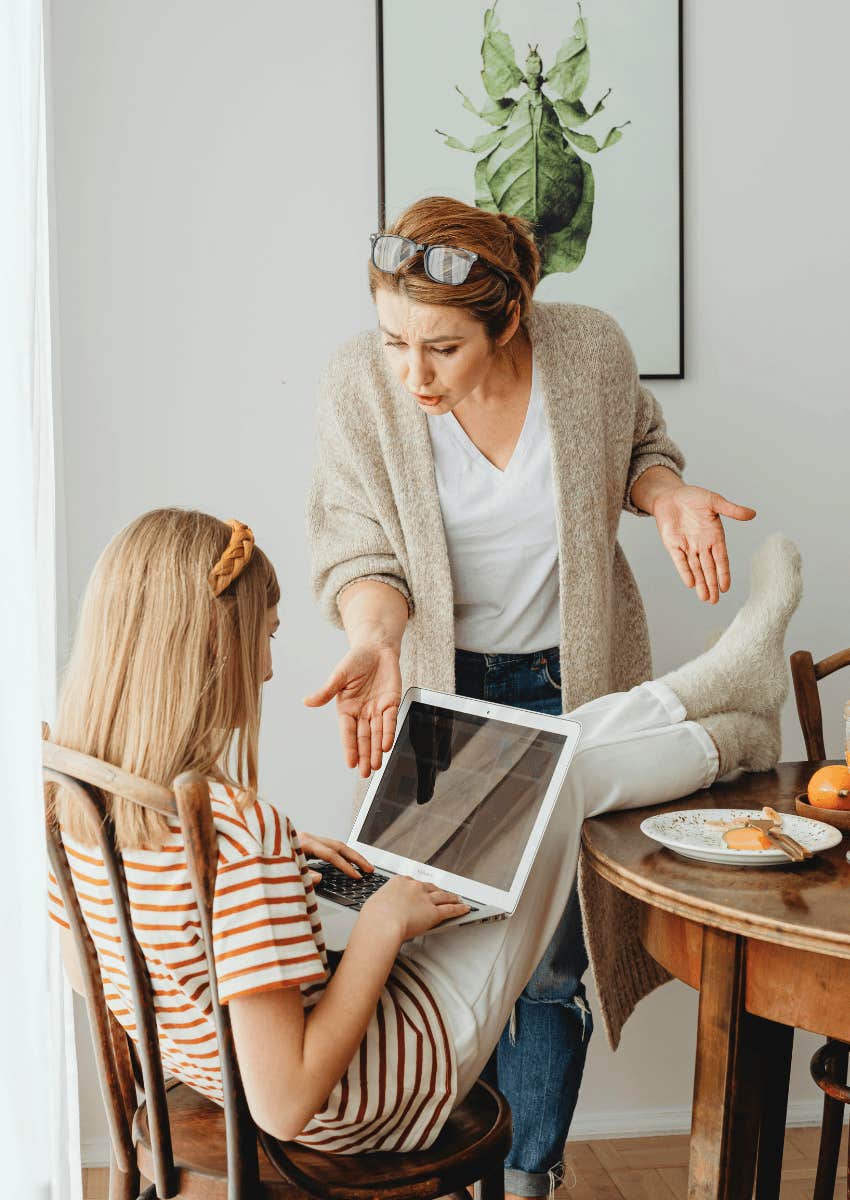
It was a sound plan, but turns out, my feelings wanted no part of it. They seemed to prefer to flop around and let themselves get bruised. A few weekends ago, when my daughter still appeared to be sleeping at 11:30 a.m., and a few raps on her door yielded only silence, I took a deep breath and ventured inside to do a pulse check. She opened her eyes as I approached her bed and said, WHAT!?
I said, “Oh, good, you’re alive.” My voice may or may not have contained just a hint of sarcasm.
She said, “Have you ever heard of knocking?”
I said, “I did knock.”
She said, “Whatever.”
I said, “It’s a beautiful day!”
She said, “Can you go now?”
At which point I sighed very loudly and exited the room, perhaps letting my feet make contact with the ground a bit more forcefully than was necessary, and while not exactly slamming the door, definitely shutting it with a little extra oomph.
I am not a religious person, but many mornings I find myself muttering the same prayer: God, please grant me the strength to not get into it with my 14-year-old today.
 www.kaboompics.com / Pexels
And there I was, three minutes into my first exchange of the day with my daughter, and God had already failed me.
My 10-year-old son, perhaps feeling left out, has now decided to get in on the action, passionately arguing his case against doing whatever it is I’ve asked him to do. He now offers me only half-hearted side hugs before school, refusing forehead kisses because they will mess up his hair.
I had thought that sharing a home with two condescending, antagonistic older children whose brains aren’t yet fully developed would be the challenge of parenting adolescents. But it’s not.
I should already know this. My stepson, now 26, lived with us full-time when he was 15 and 16. He was generally polite to me, and though he certainly had his moments of know-it-all condescension, I did not start my mornings bargaining with a higher power I wasn’t quite sure I believed in.
During that year, our daughter was deep in the throes of threenagehood, and our son was not yet walking. I realized very quickly that parenting children, particularly young children, and parenting adolescents were two very different things. Though my daughter pushed limits daily, we were still in control of what she consumed and how she spent her time.
My stepson, not so much. Our ability to carefully orchestrate our children’s lives slips away gradually over the course of many years, but when adolescence hits, the director’s chair is violently wrenched out from under us. We lose control of the plotline, fade into the background of the story we thought we were creating.
This is the expected progression of things. I get that. As our children mature, they become more independent, and their friends begin to take center stage. I’ve even quite enjoyed their burgeoning independence, particularly their ability to get themselves to and from school.
The hardest part of parenting my teens is watching them succumb to broader forces of socialization beyond my control.
 Pavel Danilyuk / Pexels
I’m as worried about peer pressure and fentanyl and social media as the next parent, but my concerns go far beyond risky behavior. As I’ve watched my children assert their growing independence, I’ve also watched their sense of self become defined by a broader culture that is inherently toxic. It’s a culture rife with racism and misogyny, a culture driven by dominance and disconnection.
Over a recent dinner, during which my daughter kept sighing dramatically and clinking her silverware with unnecessary force, I finally turned to her and asked her why she was acting so mad.
She said, “Why shouldn’t I be mad? Everything sucks. The world might end, people are racist, men think they’re better than women, and there are people addicted to drugs sleeping on the streets!” Well, she has a point there.
As parents, we bring our children into this world and therefore feel a certain sense of obligation to convince them it’s a world worth living in. No one puts it better than poet Maggie Smith in her poem, Good Bones:
Life is short, and the world
is at least half terrible, and for every kind
stranger, there is one who would break you,
though I keep this from my children. I am trying
to sell them the world. Any decent realtor,
walking you through a real [expletive], chirps on
about good bones: This place could be beautiful,
right? You could make this place beautiful.
What my daughter is learning is that there is at least as much ugliness in the world as there is beauty (a “conservative estimate,” says Maggie Smith in the same poem), and she’s rightfully upset about it. As she’s questioning everything she thought she knew, she is also questioning her own worth. She’s finding the world doesn’t stack up, and neither does she.
For my stepson, adolescence was a time of slow hardening. He built walls, clenched his vulnerabilities like fists. For my daughter, adolescence has manifested in a slow taming, a shedding of confidence that began right on schedule at age nine and continues its grim march forward. It’s difficult for me to watch, particularly as a 45–year-old woman who is finally reclaiming my own sense of self-worth after decades of never quite feeling good enough.
I see my teenage daughter starting to internalize all the things I’ve spent the last few years trying to unlearn.
All the messages about what a female should be interested in, how a female should behave, and how a female should present herself. As I’m gleefully shedding high heels and all the time and effort I once gave to what other people think, my daughter is accumulating product after product in a frantic and unrelenting quest to fix all the flaws she now perceives in herself.
She is not only a female but a biracial female who presents as Black, and I feel slightly heartsick at the prospect of having to release her into this world. It’s a better world, in some ways, than the world that awaited me. But in other ways, too many other ways, it’s undoubtedly worse.
I didn’t wholly anticipate this. When my daughter was born, Obama was president, and I thought we’d reached a turning point.
My daughter is mad, and she has every right to be. The world is at least half terrible, and she will experience its terribleness disproportionately simply by virtue of her gender and skin color. And not only that, she is the only 14-year-old in the entire world — scratch that, universe — who is forced to go on hikes and whose mother considers peanuts to be a viable snack option.
The rage is there, simmering if not boiling, and she doesn’t always know what to do with it. Rage is for men, after all. Anger doesn’t become the gentler gender.
Right now, I bear the brunt of this rage because I’m an easy target, and hey, maybe I deserve it sometimes. If nothing else, I brought her into a world that I knew was at least half terrible. I thought maybe we could make it beautiful. Maybe we still can.
Kerala Goodkin is an award-winning writer and co-owner of a worker-owned marketing agency. Her weekly stories are dedicated to interrupting notions of what it means to be a mother, woman, worker, and wife. She writes on Medium and has recently launched a Substack publication, Mom, Interrupted.

