
The Older You Get, The More You Realize Some Days Feel Deeply Lonely, Even When Life Looks Full
 Jasteri | Shutterstock
I'm not always an easy person to be around. I'm sure that most people feel that way, and to some extent, it's probably true. But there are times when I'm particularly, especially, really awful to be around.
What makes these times even more difficult is that they usually coincide with my periods of a mental health crisis. A study helped explain that the point where my behavior is most likely to drive my friends away is also exactly when my self-esteem is at its lowest ebb. The older I got, the more I realized some days feel deeply lonely even when life looks full.
The older you get, the more you realize some days feel deeply lonely, even when life looks full:
1. Your feelings are real, but they aren't always telling you the truth
Research has been clear about treating feelings as symptoms rather than the disease, which is to say, do what you can to alleviate them while at the same time looking for a root cause. I don't have a very good instinct for boundaries. I have a hard time enforcing my own rules, and I'm not always good at respecting others' rules.
For a long time, my personal boundaries were treated more as points of negotiation than as hard lines, and, as a consequence, I don't have a very solid foundation for understanding how they work.
If someone spells them out to me, that's fine, but in my experience, that kind of articulation often doesn't happen until after the relationship has been damaged and feelings have been hurt. I'm a great friend until I'm not. I'm fine except when I'm in a crisis, which, in a bad year, can last for several months on end.
2. When you're deep in it, nothing anyone says really fixes it
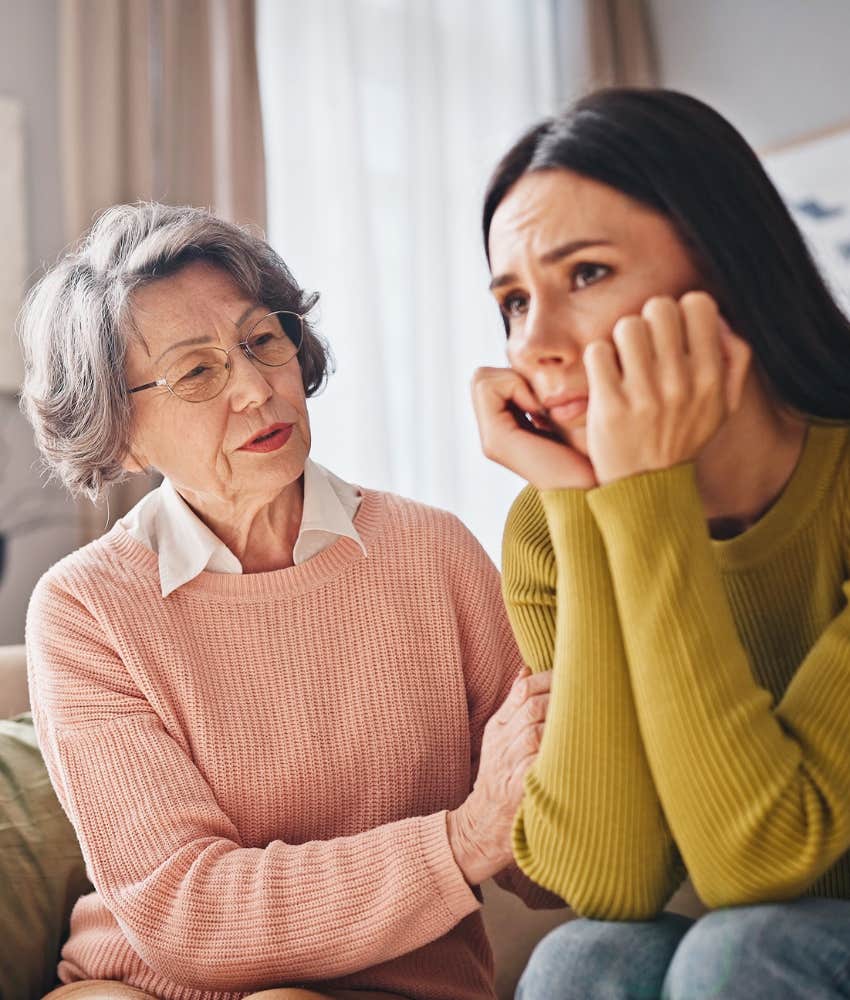 M_Agency via Shutterstock
The best they can do is hold your hand while you go through it. I'm a crier. I'm someone who panics loudly. I'm a person who feels dread everywhere, in my teeth and the tips of my fingers and deep in my bones. There are days when I know with absolute certainty that I'm a miserable monster who will never feel happiness again.
I have sat in my living room at three in the afternoon and three in the morning, and every hour in between, consumed with unhappiness so intense I'm not sure how to describe it except to say that it just is, and a study described this feeling as "being unstuck in time."
It swells up so huge inside of me, it obscures everything else, including my sense of self and the passage of time, so there's no more past, and there's no more future, and there's just this exquisitely awful present that feels impossible to escape. I know. I know. But also, that's just how it is sometimes, you know? Once you're there, you just keep going further down the rabbit hole. All you can talk about is what an awful person you are, and the more you say it, the truer it feels.
3. You have to prepare for the hard days while you're still okay
I have a Word document of all the reasons why my friends probably don't hate me. I go through the list and read, feeling like all of my friends probably hate me. When your friend disagrees, you get angry and accuse them of not being on your side (the joke is, of course, that no one is on your side because what the heck is your side).
You show up at their place crying, asking if you can crash on their couch because you're not sure you can handle a night alone. When they call to check on you, you say that you're feeling scared to be alone with your own thoughts.
These are all awful things to do, and I'm ashamed to write them out, but at the time, they felt inevitable. I didn't know how else to be, and every new friendship meant counting down the minutes until they discovered the real me, the awful me, the one who cries over dinner, in the grocery store, during a very normal conversation that shouldn't be sad at all.
4. Give yourself time before making big decisions
You might be making the right choice, but it rarely hurts to give yourself some breathing room before committing. I felt like I'd tricked people into wanting to spend time with me. A study found that much of my mental and physical energy was spent maintaining the image of an upstanding, not-awful person I was. That is, until the next rough patch hit, and I couldn't sustain it anymore.
I didn't drive every friend away. But I can honestly say that I did drive some friends away. When I was going through a particularly hard time in university, a friend that I often leaned on for support, let's call her C, suggested that I make a list of all the things I hated about myself. "Once you've got that list," she said, "You'll know what you want to change."
5. Build a space where you can show up as you are
 Krakenimages.com via Shutterstock
A group chat with friends you trust or a Facebook page where people can post stuff for you and commiserate about mental health woes. I know this isn't everyone's jam, but I live in terror of exhausting people with me, so it's better for me to have an opt-in system where friends can choose to participate if they feel up to it.
C was big on self-improvement. She did stuff like quitting the school's meal program and buying herself a bar fridge so that she could better follow The Zone diet in the privacy of her own dorm room. She was the kind of person who always seemed to intuitively know what she needed: a new rug for her room, an hour at the gym, a quiet night in watching Sense and Sensibility. And, in marked contrast to me, she didn't have frequent weepy meltdowns about how much of a mess her life was.
So when she suggested writing out all the worst things about myself, I readily agreed. After all, if I couldn't identify the problem, how on earth was I going to come up with a solution?
6. You've made it through every bad day so far
100% is the best possible rate. You have made it through every bad day so far, and the statistics are on your side for the next one. With my survival rate in mind, I parked myself in the library's atrium one afternoon to make my list. Another friend, let's call her K, asked me what I was doing.
When I told her that C had told me I could improve my life by thinking up all the things I didn't like about myself and then changing them, K said something like, "You know what will really improve your life? Getting rid of the friends who tell you to make lists of the things you hate about yourself. Maybe start hanging around with the people who want you to like yourself for who you are."
7. You don't always need to measure the good days vs. the bad
I'm not sure it's worth counting them, but I do know that after each storm blows itself out, I'm always grateful to still be here. If you're in a bad place, I hope some of this helps.
I've realized that both C and K's ideas have merit. I should be able to expect that my friends love me for who I am, including the wailing banshee that lives somewhere in the shadowlands of my heart, who believes that she's anything but lovable.
But I should also try to take responsibility for what I say and do when that banshee does her best to trash the party and leave. Because that banshee is me and I'm that banshee, and even though I'm still not quite sure what to do with that information, I know it's important.
I've seen a few debates about what the "right" kind of self-care is. Should you do the dishes or leave them in the sink while you take a nap? Should you make good on your plans and go out with friends even when you feel terrible, or should you bail with some transparent excuse? Should you clean your room or hunker down with a good book and let your future self worry about picking up your clothes?
I don't think there are any cut-and-dry answers to these questions. There's no good way to have a mental health crisis.
Sometimes it's smarter to wash your dishes, and sometimes you need a break, and it's hard to know at the moment which one is true. On the one hand, a messy apartment makes me feel like the world is closing in on me, but on the other hand, the best prescription a doctor ever wrote for me said, "Do more things that you enjoy."
Maybe the thing that feels worst isn't making a choice and spending four hours sobbing on the couch, unable to decide whether you should clean the bathroom or make yourself a cup of tea.
Anne Theriault is a writer and contributor to YourTango.
If you're struggling, help is available. Call or text the Suicide & Crisis Lifeline at 988 to connect with real people who care and want to help.

