
11 Old-School & Nearly Forgotten Parenting Habits That Quietly Helped Kids Become Capable Adults
 Lithiumphoto / Shutterstock
It’s no secret that people in younger generations, including Gen Z and Gen Alpha, have been raised differently than previous ones. If you think about it, that’s actually a normal part of how society evolves. Each generation has its own quirks and habits.
However, there’s still something to be said about old-school habits and ways. They were popular for a reason. Many of the best practices we had ended up fading into the background. Don’t believe me? Take a look at these habits that made people into more capable adults later on.
Here are 11 old-school & nearly forgotten parenting habits that quietly helped kids become capable adults
1. Letting kids wander around town unsupervised
 Inside Creative House / Shutterstock
Perhaps the biggest habit change I’ve personally noticed is the obsession with parental supervision that’s gripped America. In the 80s and 90s, it was fairly normal to see kids as young as 12 riding bikes around town without a parent in sight. Today, even playing in the front yard without a parent nearby could end up in a call to CPS.
This initially started as a concern over “stranger danger,” but it quickly evolved into helicopter parenting and overbearing parental behavior. As it turns out, hovering around your kids 24/7 isn’t healthy. Psychologists discovered that overbearing parents tend to cause their children to behave in obsessive, codependent ways.
2. Insisting kids to go to the parties of unpopular children
 Zoran Zeremski / Shutterstock
Back during my early childhood, many parents often insisted their kids attend birthday parties, even of children they didn’t particularly like. Kids went, and at times, it actually kicked off a beautiful friendship. Today, that’s not the case. Some parents are even choosing to make their children forgo all parties.
However, that’s not a healthy move. Speaking as one of those kids who had no one attend their birthday party, parents don’t understand how awful being on the receiving end of that treatment is until it happens to their own children. Secondly, kids who have to go often learn new skills to make awkward situations a lot more pleasant. Those skills can be lifesavers later on.
3. Teaching kids to write in cursive
 EF Stock / Shutterstock
It’s true. Cursive is no longer being taught in several states, with many more debating on whether it’s worth the effort. Cursive, or “script,” was actually a writing style designed to help children learn how to hold a pen and write before they got to standard letters.
This seems like such a weird habit to kill off, doesn’t it? Though cursive is rarely used in most people’s day-to-day work, not being able to read or write it effectively blocks off a person’s ability to read older notes passed down from generation to generation, and that could very well include grandma’s favorite recipes.
4. Mandatory chores
 Prostock-studio / Shutterstock
As a parent, I was shocked to find out how many parents don’t have their kids do any chores around their homes. I shouldn’t have been, since I had to teach some of my college classmates how to fill out a check and how to do a decent batch of laundry.
In earlier generations, chores were a typical part of daily life. That habit started to die off by the 90s, and a lot of people are starting to realize what a loss it truly was. Those chores helped teach kids the basic steps of being a functional adult and also helped young adults avoid getting fleeced by laborers they didn’t need. Psychologists agree that chores are good for kids.
5. Allowing consequences to happen
 MAYA LAB / Shutterstock
Does it seem like most parents try to cushion the blow of consequences and failure for their children? If you’re like most people, you probably noticed it too. You may have seen parents who complained to their teachers about their kids’ grades, parents who used their influence to get kids into special programs, and parents who managed to talk to judges in a way that gets kids off the hook.
While it might seem like they’re just protective of their kids, the truth is that this behavior hurts a lot of people. First, it lets their children learn that they won’t ever experience consequences. Second, it’s unfair to others in that situation if they don’t have the means to get their kids ahead. Third, it wrecks the integrity of multiple institutions, including schools and the US court systems. Fourth, it leaves kids unprepared to deal with consequences as adults.
6. Eating dinner with the family
 Josep Suria / Shutterstock
Not too long ago, there was a public service announcement encouraging parents to eat dinner with their kids. It seemed like such a silly thing to me at first, but then it dawned on me that many children don’t experience a regular dinner with the family. As it turns out, the PSA was done for good reason.
Hannah Leib Schlichter, LCSW, shares that dinner with the family has major impacts on everything from self-esteem to mental health and academic performance. So, if you want your kids to turn into happier adults, try to pass them the potatoes during dinner time.
7. Teaching table manners
 Drazen Zigic / Shutterstock
Do you know the difference between a salad fork and a dinner fork? What about a dessert spoon versus a soup spoon? Do you know which way to set a table properly? These questions are easily answered if you’re a person raised by “old-school” parents.
Table manners might seem outdated, but they really aren’t. Seeing someone eat with poise is a lot more pleasant than watching someone snarf down food. Besides, having that fine dining training can be quite useful if you want to network with the upper echelon of society. Some studies even suggest that table manners can help reduce bullying.
8. Letting kids get bored
 MAYA LAB / Shutterstock
Boredom seems to be the new four-letter word. Among major companies, boredom (or even a slow pace) is a warning sign. It’s a klaxon saying their marketing failed. They want kids hooked on their entertainment 24/7, even though high-stimulation cartoons have been linked to a decline in attention span.
Believe it or not, kids actually need to get bored from time to time. It’s a way to help them cope with waiting in line, to help them recharge their brain’s batteries, and to keep their attention spans strong.
9. Saying no
 Dragon Images / Shutterstock
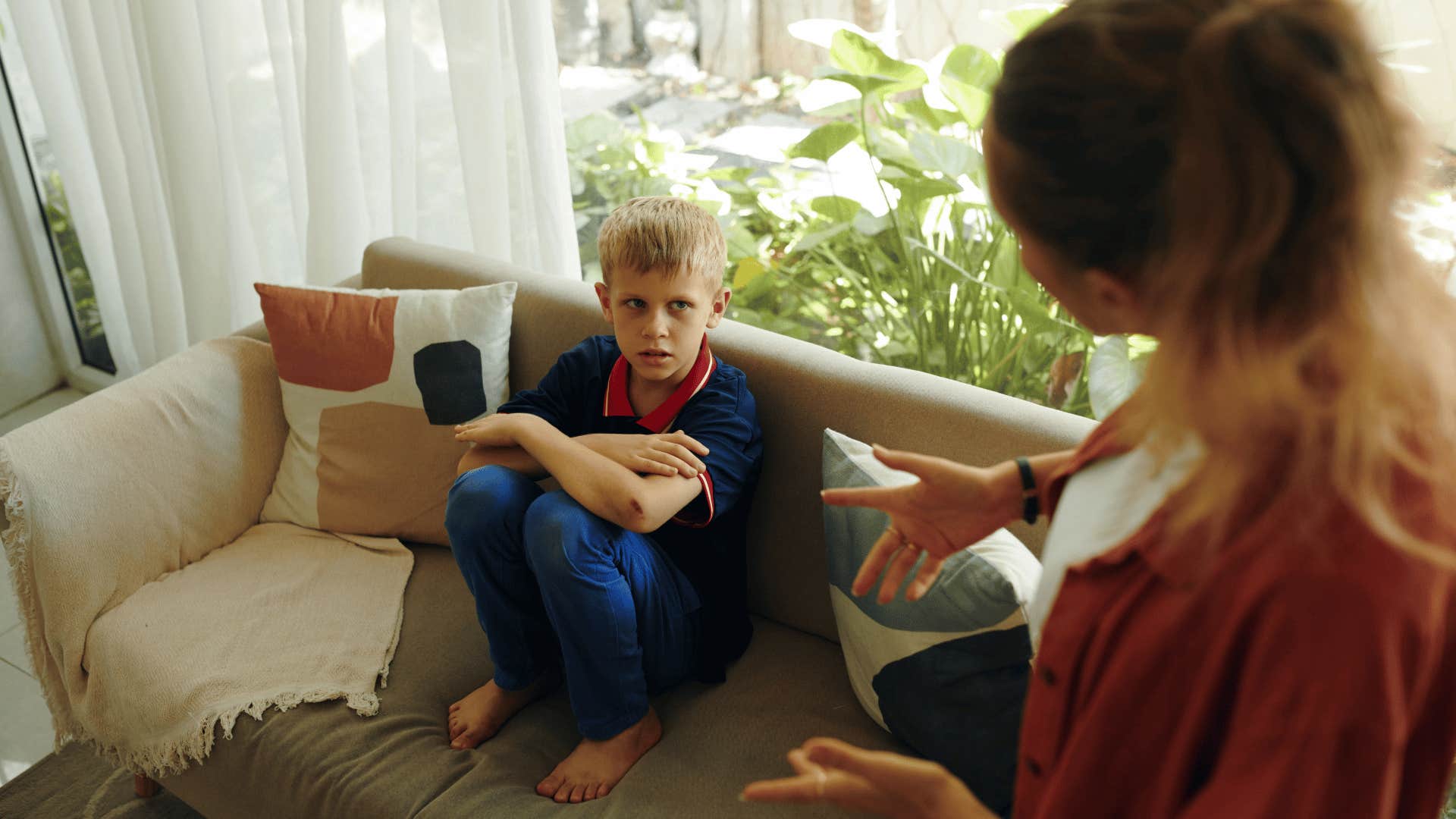
While this is not a universally forgotten art, I’ve noticed that many parents struggle to set boundaries with kids. It only takes one kicking, screeching tantrum for most parents to capitulate when it comes to their child’s demands. I’ve heard more than one frazzled mom say, “What do you want me to do? Say no to his iPad?!”
Actually, yes. That would be ideal. Kids who aren’t told “no” early on in life tend to become adults who won’t take no for an answer later on. Oddly enough, these same parents are often bold about teaching their kids to say no to others’ requests. No is a two-way street. No is healthy for everyone.
10. Trusting kids
 fizkes / Shutterstock
Did you notice how many parents don’t seem to trust their kids to have common sense? It’s been a quietly-growing trend in recent years, often encouraged by society’s constant criticism of parents. This wasn’t the way that most older generations were raised. Quite the opposite. Their parents often trusted children to act responsibly, even at a young age.
There used to be a time when parents would trust 12-year-olds to pet sit or babysit. That time seems to be long gone, and it’s quietly starting to show up in weird, messed-up ways. Simply put, it’s causing young adults to get increasingly infantilized, too.
11. Letting kids rest
 suriyachan / Shutterstock
One of the biggest culture shocks I've had in recent years was overhearing that many parents enroll their children in over half a dozen clubs every semester. When I was young, it was seen as insane and was a habit done solely by “tiger parents.” People knew it was overloading kids.
Today, that’s become the norm in many circles. Moreover, homework loads have started to increase across the board. Kids don’t have time to rest, play, or really just exist without structure. That’s a crime, in my opinion. Everyone needs a little bit of time to chill out, otherwise you’ll run yourself ragged.
Ossiana Tepfenhart is a writer whose work has been featured in Yahoo, BRIDES, Your Daily Dish, Newtheory Magazine, and others.

